
What I Didn’t Expect When I Paid Off My Car Loan
The Post That Sparked Something Bigger
Last week, I shared a post on LinkedIn about something I’ve been working toward for a long time: I’m officially done with my car loan debt.
What I didn’t expect was the response.
So many people celebrated with me, and just as many reached out to share their own experiences, especially those who made the intentional choice to stay out of car loan debt altogether.
That part really stood out. It turned into something bigger than just a personal milestone for me, it became conversations. Missed it, read it here!
A Goal I Kept Circling But Not Fully Acting On
Paying off my jeep has been a goal of mine for several years.
And yet, if I’m honest, I can look back and see a pattern I didn’t fully break for a long time: the cycle of trading in vehicles, rolling over equity, and convincing myself that a newer car was the “right” financial move in the moment.
Sometimes I truly needed a different vehicle. But other times, I was justifying it.
And even though I always made the minimum monthly payments, I wasn’t always intentional about getting ahead about making extra payments or actively shortening the timeline I kept saying I wanted to be done with.
The Work Behind the Work (and What I Do for a Living)
For those of you who know me, you know I work in financial education.
I often say my job is financial education by day (I also love to write, speak, and podcast). I spend a lot of time talking about money habits, stress, and behavior change through workshops, events, and sessions.
But last week reminded me of something I should talk about more. Even when something is a financial goal, you don’t always realize the emotional weight it carries until it’s actually gone.
The Moment It Became Real
The moment I made that final payment, I remember sitting there and just exhaling. It was a quiet moment, but I felt a deeper release than I expected.
And then, interestingly, it took a couple of days for it to really sink in to celebrate. Not just that the balance was zero in the app, but that something else had changed too.
It wasn’t just the debt that was gone.
It was the background noise I had gotten used to living with.
Financial Stress Is More Than Numbers
It made me reflect on something I talk about often but experienced in a deeper way.
That being that financial stress doesn’t just show up in numbers. It shows up in your energy, your decision-making, your mood, and so much more in everyday life.
There’s a statistic I often share in sessions and it's that around 91% of people report being stressed about their finances, according to BrightPlan.
I realized in that moment of relief, even though I’d planned for it financially, how much more joy came from the freedom of being finished. I was happy dancing!
The Conversations That Followed
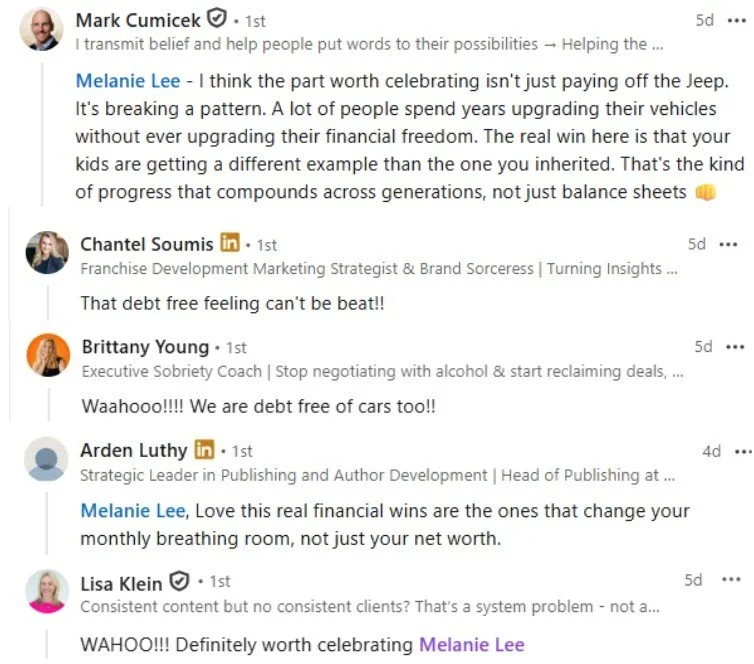
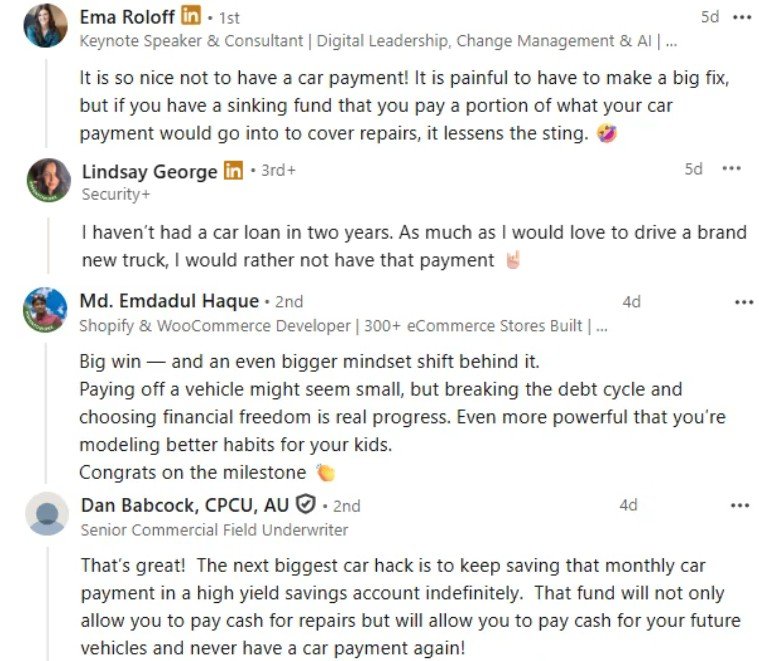
What surprised me most after I contemplated making that post was the comments and the conversations that followed after it. Here's proof to just make the post!
So many people reached out to celebrate the win with me. And just as meaningful, others talked about intentionally paying off car debt too.
They talked about what that choice has meant for them with less stress, more flexibility, and a different kind of freedom that comes from not carrying that monthly obligation at all.
It proved that talking about financial goals with other people can be really motivating and grounding.
Breaking Generational Financial Patterns
A lot of my thinking around this pattern comes back to how I grew up.
We took loans out for everything. It was normal. It was expected. And more often than not, life operated in a paycheck-to-paycheck rhythm that didn’t really leave room to question it. It just was the way things worked.
Over time, that becomes more than financial behavior. It becomes a generational norm. And if you’re not intentional, you can carry those patterns forward without even realizing it.
That’s part of what I’ve been working to change in my own life. Not just the numbers, but the behavior behind them. Because financial behavior isn’t only about information. It’s about familiarity. What feels normal. What you’ve seen repeated enough times that you stop questioning it.
And breaking that cycle takes more than intention. It takes awareness, repetition, and sometimes unlearning what once felt like the only option.
Teaching a Different Way Forward
One of the most meaningful parts of this journey has been watching my own young adult kids approach money differently than what I grew up with.
That’s something I’ve intentionally tried to instill. Not just by talking about money differently, but by modeling a different way of making decisions.
Seeing them put money down on vehicles instead of automatically financing everything… seeing them think ahead instead of defaulting into debt… that feels like something deeper than basic financial literacy.
It feels like generational progress.
And honestly, it feels like parenting progress too.
Emotional Relief Is Part of Financial Progress
One thing I’ve been thinking about more lately is how we don’t always connect financial progress to emotional relief.
We talk about budgeting, debt payoff, and investing, but we don’t always talk enough about the mental and emotional shift that happens when pressure is lifted.
Paying off my jeep didn’t just change a number on a statement. It changed the background noise in my mind. It made me realize how long I had been carrying something I had normalized as just part of life and how much lighter things can feel when that layer is gone.
That’s part of what I’ve been thinking about more this past week.
When we don’t expect it, debt can quietly take from our happiness in ways that go beyond the numbers. It shows up in the monthly planning, the mental space it takes to account for every payment, and the way certain costs always feel slightly anchored to something already spoken for. Over time, it becomes part of the background of decision-making, even when we’ve normalized it.
And it also made me reflect on how easy it is to stay stuck in cycles that don’t actually align with the goals we keep saying we want. Honestly, not because we don’t care, but because behavior change is harder than intention.
Finalizing the Blog
I’m sharing this not as a “look what I did” moment, but as a reminder for anyone else who has been circling a financial goal for a while.
Sometimes the shift isn’t about learning something new. It’s about finally acting on what you already know and realizing that financial decisions don’t just change your numbers, they change your sense of peace and happiness too.
Remember, Healthy Hustle Keeps You Happy!
-Melanie